X0X
| Author | Charles Vestal |
|---|---|
| Version | 0.10.3-beta (data as of 2026-10-09) |
| License | GPL-3.0 |
| Repository | https://github.com/charlesvestal/fm1-x0x |
| Web / installer | https://charlesvestal.github.io/fm1-x0x/ |
| Based on | Felucca |
| Emulates / engines |
|
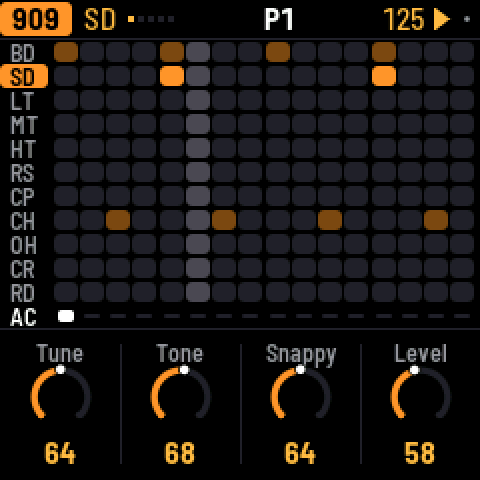
X0X is Charles Vestal (Berlin; firmware engineer at Memfault, author of the Schwung module family for the Ableton Move) doing what he’s good at: a ReBirth-style groovebox with a TR-909, a TR-808, two TB-303s and a breakbeat player, all at once, in stereo. It’s a platform-only fork of Felucca: Vestal keeps the scaffolding and replaces the entire instrument — the same pattern he repeats in FoMni. Everything gets tested in a host simulator and a browser build first; in fact, Felucca’s WASM emulator was modeled on X0X’s browser build.
Workflow
Acid, big beat and techno live: patterns, chaining, a song mode of up to 192 bars recorded live, and knob-motion recording. Each part has its own length (≤32 steps) and rate, so the parts drift out of phase with one another — free polymeter. And TB-3PO: an acid line generator on each 303 (DENS/ACCENT/SLIDE/OCTS, 6 scales, auto-mutate) that saves you from programming lines by hand.
Engines & what it emulates
909: 11 voices — modeled kick, snare, toms, rim and clap; sampled hats and cymbals (schwung-9W9 / ER-99). 808: 11 tracks with tom/conga, rim/claves and clap/maracas switches (schwung-8W8). 303 A+B: Robin Schmidt’s Open303 (MIT) with Devilfish-style extended ranges. And the breakbeat player: the loop cut into 8 slices that you reorder live (from mestela’s schwung-breakbeat). Roland’s trademarks, the README clarifies, are descriptive only.
What sets it apart
- Shared stereo reverb and delay; a clean 12-bit DIGI delay or a wobbly TAPE one, with wear and ping-pong; 909 drive and a glue compressor.
- ~9 user breaks in 3 sample slots (
tools/upload_breaks.py). - Safe mode after crashes; 13 releases in four days.
Status & caveats
Explicitly beta and very active. Dense patterns push the CPU: the firmware trades away sound quality before it lets itself fall over — under pressure it trims the sound, but there is never a dropout.
← back to FM-1 Firmwares